blue prince
08 Jun 2026 - digitalily
Blue Prince is a game that I had heard small rumblings about for quite a while, with several people online speaking very highly of it, but I never knew too much about what exactly it was. What I did know was that it was in a decently long early access, and was being made by someone who at the time was very much a non-developer, but that was about it. It wasn't until a friend had started playing & loving it, even going so far as setting his desktop background to a stylized blueprint sketch of the manor, and him having roped a couple others in that I finally sat down to give it a try. Around this time as well, a streamer who I'd known of since long ago had on several occasions spoken about how it was easily his favorite game of all time during his Silksong let's play, so hype and expectation was there. And so, while on a vacation flight around the holidays, knowing it was a good 'Steam Deck game,' I flew up to 30,000 ft. and launched it. Immediately after watching the opening cutscene and walking into the first randomly drawn room, taking in the sounds and atmosphere, I closed the game with a firm understanding that I absolutely had to play it full screen on my desktop, and so I waited.
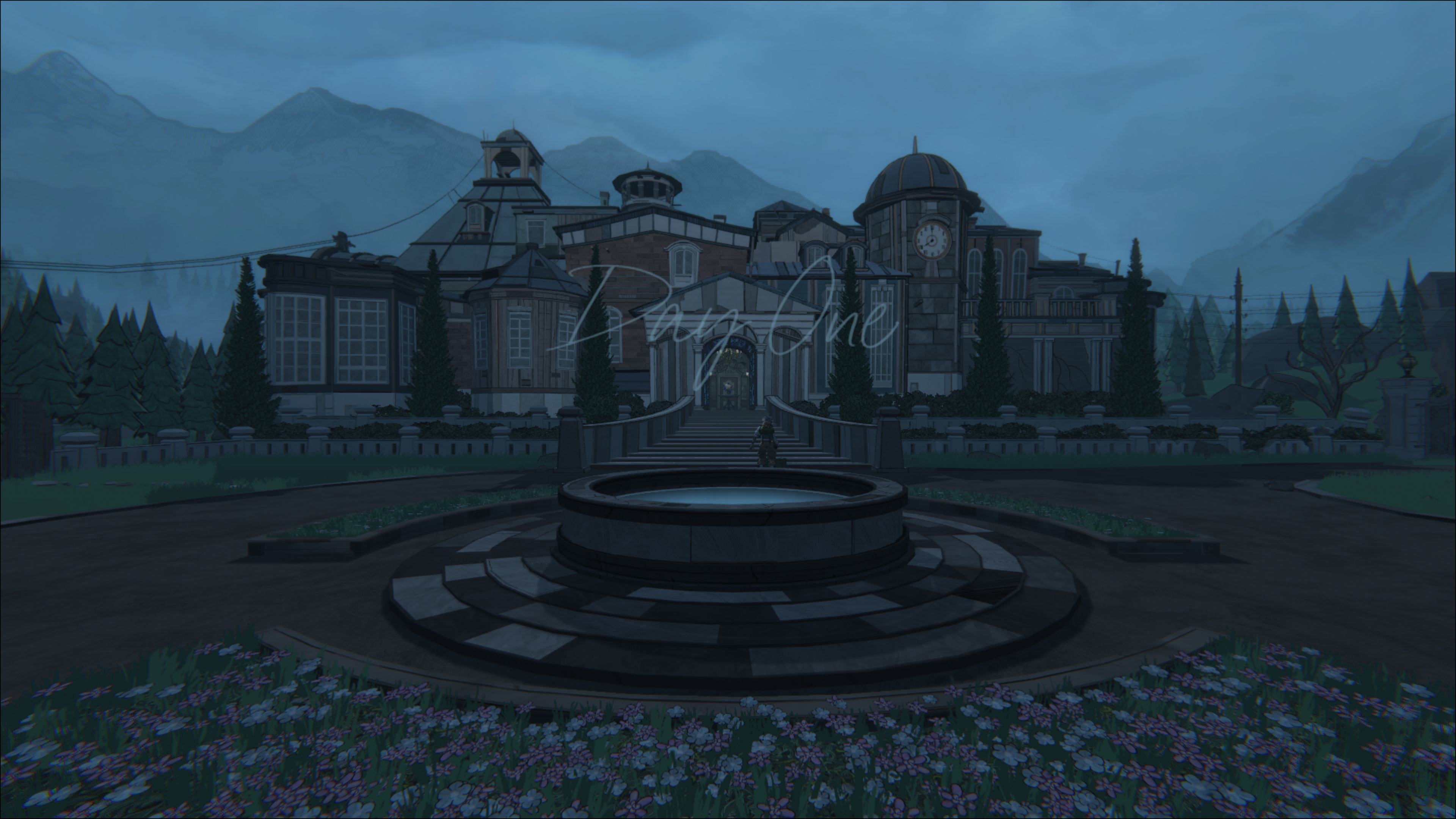 day one of many
During the intro cutscene, the general gist is laid out. You play as Simon P. Jones, the nephew of late eccentric Baron Herbert S. Sinclair, who prior to his death suddenly revoked all previous wills and bequeathed the entirety of his estate (known as Mt. Holly) and all within to Simon on the condition that he locates the 46th room of this 45 room manor- this being the initial main goal of the game. 46/45 is sure a way to pique some interest, that's for sure. The gameplay itself is (broadly) speaking a sort of roguelite, where each day you begin in the Entrance Hall, which has north, east, and west exits blocked by simple closed doors. When you open a door, you are given a selection of three (mostly) random rooms, each of which has 1-4 doors, and can be in a particular rotation. The overall house layout is 5 columns of 9 rows, with only the bottom center (Entrance Hall) and the top center (Antechamber) initially filled out- to get to Room 46, you have to 'draft' rooms from room exits to snake your way up to the top and figure out how to get past the antechamber along the way. Generally, you aren't going to get this on your first run, as you've yet to unlock several permanent additions/upgrades that make this task much simpler, though horrifyingly enough there is an achievement for actually doing this in a single day. One I don't plan on taking on anytime soon.
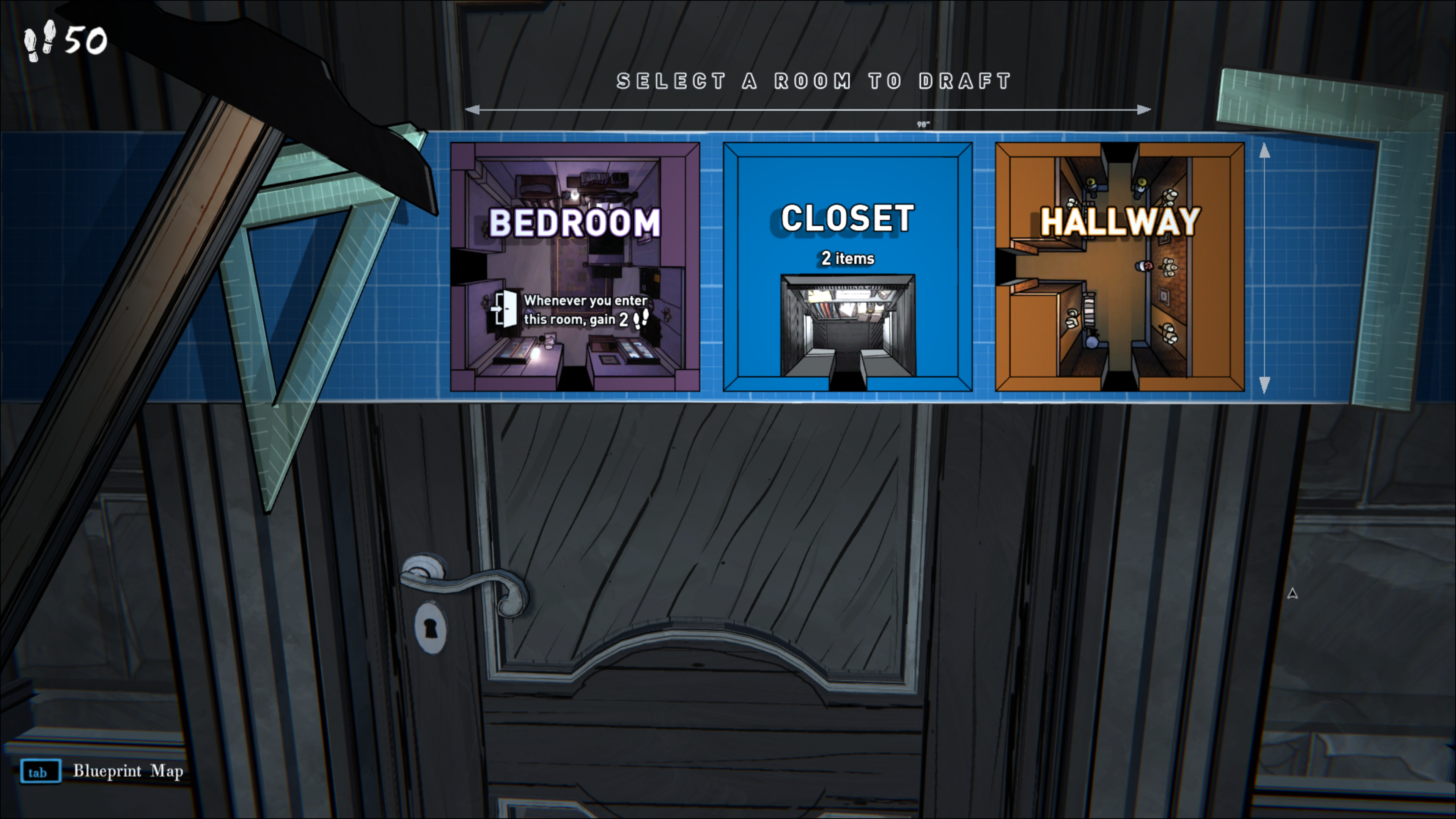 an example of drafting a room
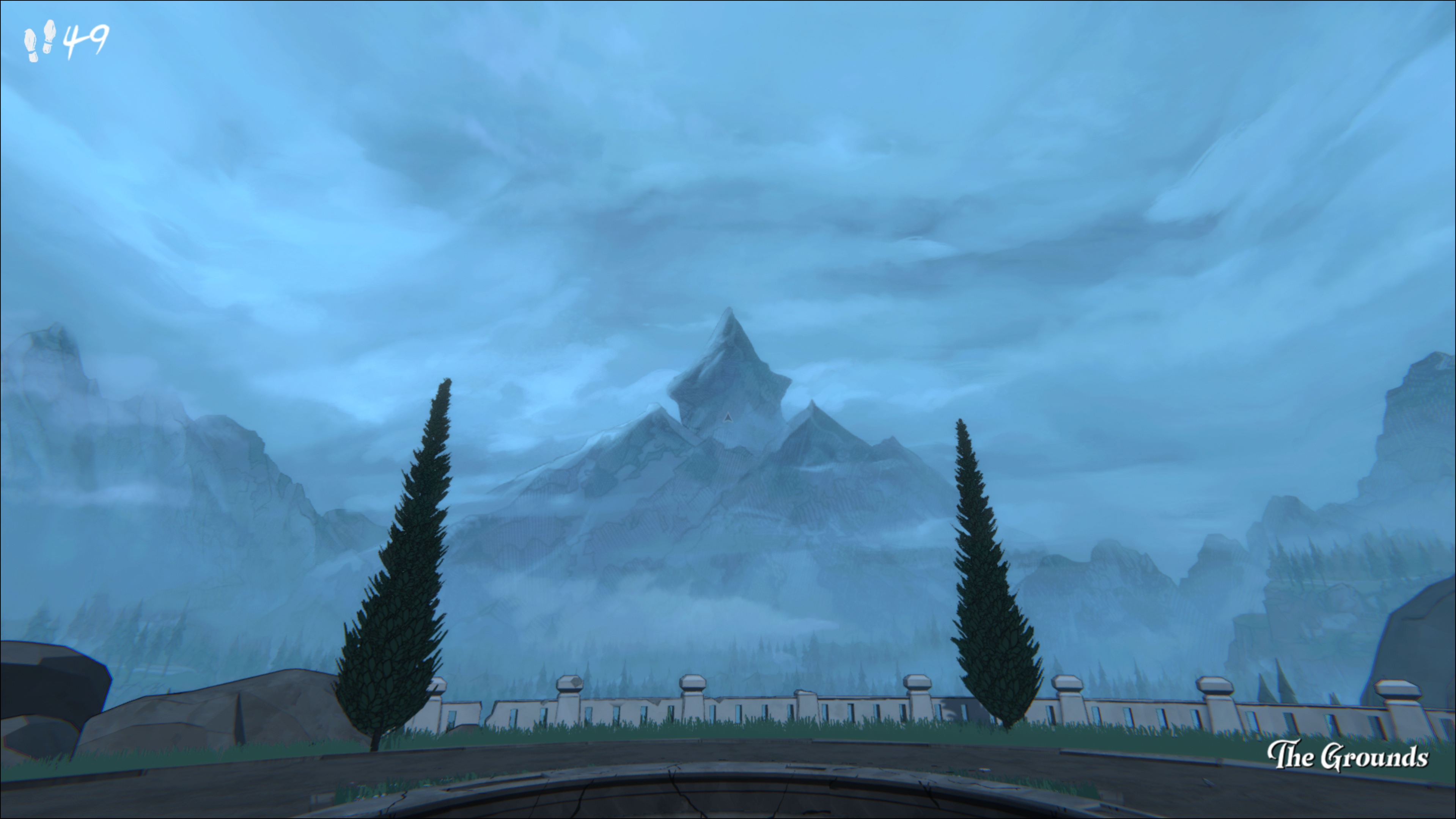
The main limiting factor within a day's run is your step counter, which decreases whenever you cross the threshold between rooms, or certain areas in general, such as if you go back out of the Entrance Hall into the The Grounds or further. When you hit 0, Simon essentially tires out for the day, and you return to your tent outside to rest for the next day- you aren't allowed to stay in the estate overnight, giving time for the rooms to reset and for you to try again. Steps can be increased via a permanent upgrade or more commonly, by food items you can find around the house, either laying around in certain rooms or bought from a shop. Certain rooms may also restore some steps, or take steps away from you, meaning you have to be careful what paths you follow in case you end up at a dead end or locked door you don't have a key for, in case you need to backtrack- and you will, inevitably, have to backtrack. Your resources will also limit you, needing gems to pay to unlock certain rooms, coins to buy useful items, and keys to open locked doors. Some doors may also be blocked by needing a special keycard, unless you can find an alternate way to get through them. And if you find yourself drafting your last room and no matter what you pick it marks the end of your run, you'd better hope you have some ivory dice to reroll the offered selection.
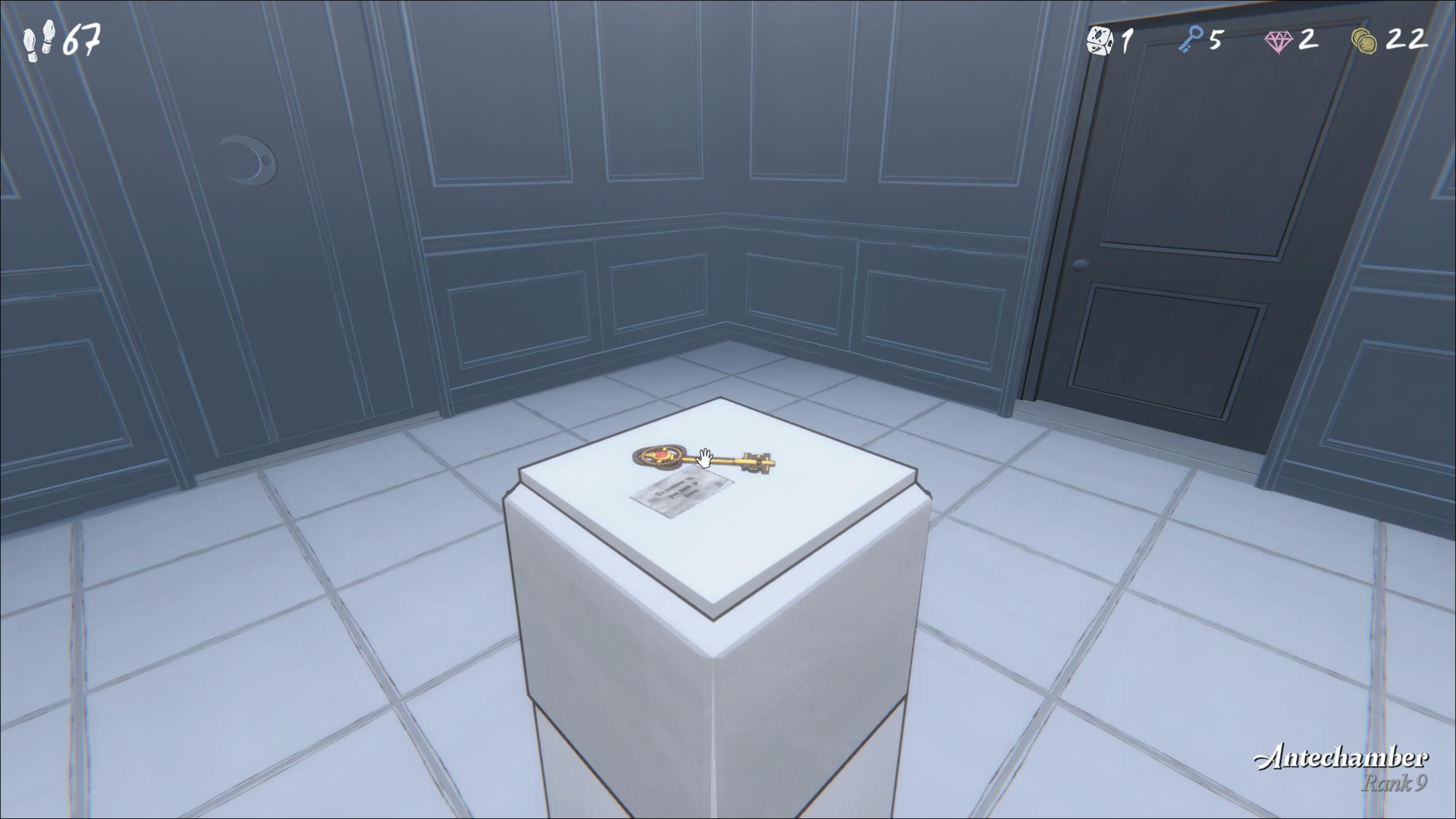 the antechamber
Breaching the antechamber doesn't ultimately take too long, though RNG can greatly influence this, and upon reaching it for the first time, you are presented with a cutscene that, depending on how much you have seen up until then, will have more or less weight. This is because as you journey through the estate, you will come across photographs, scrawled notes, books, a fortune teller?, and many other things of interest that serve two main purposes. The first is to provide context to the world you're in. You may find an old newspaper clipping with reference to an older denizen of the estate who has long since passed, or you may find a cute illustrated picture book or a redacted history of the country this all takes place in. It is in my opinion, these sorts of finds which serve to give that Room 46 cutscene as much weight as it is. But the second purpose of these things, is to plant seeds of mystery, or provide clues towards some thing or other. You may find a note referencing the location of a lever in a room you've been in before (and certainly having seen no lever), or you may find a combination lock to a safe with no written down code in sight, or you may find a blackboard with a strange grid on it that happens to match the 9x5 layout of the estate. And it is these sorts of clues and puzzles ultimately intertwined with the history, geography, and people you learn about, that truly form the bulk of what this game is, as when you visit Room 46 for the second time (noting that the cutscene for the first time ends your day automatically) and can actually explore the room itself, you find a note detailing in riddles 8 locations where you can find particular keys, which, if you've made it that far, you should have a pretty good idea as to where they go.
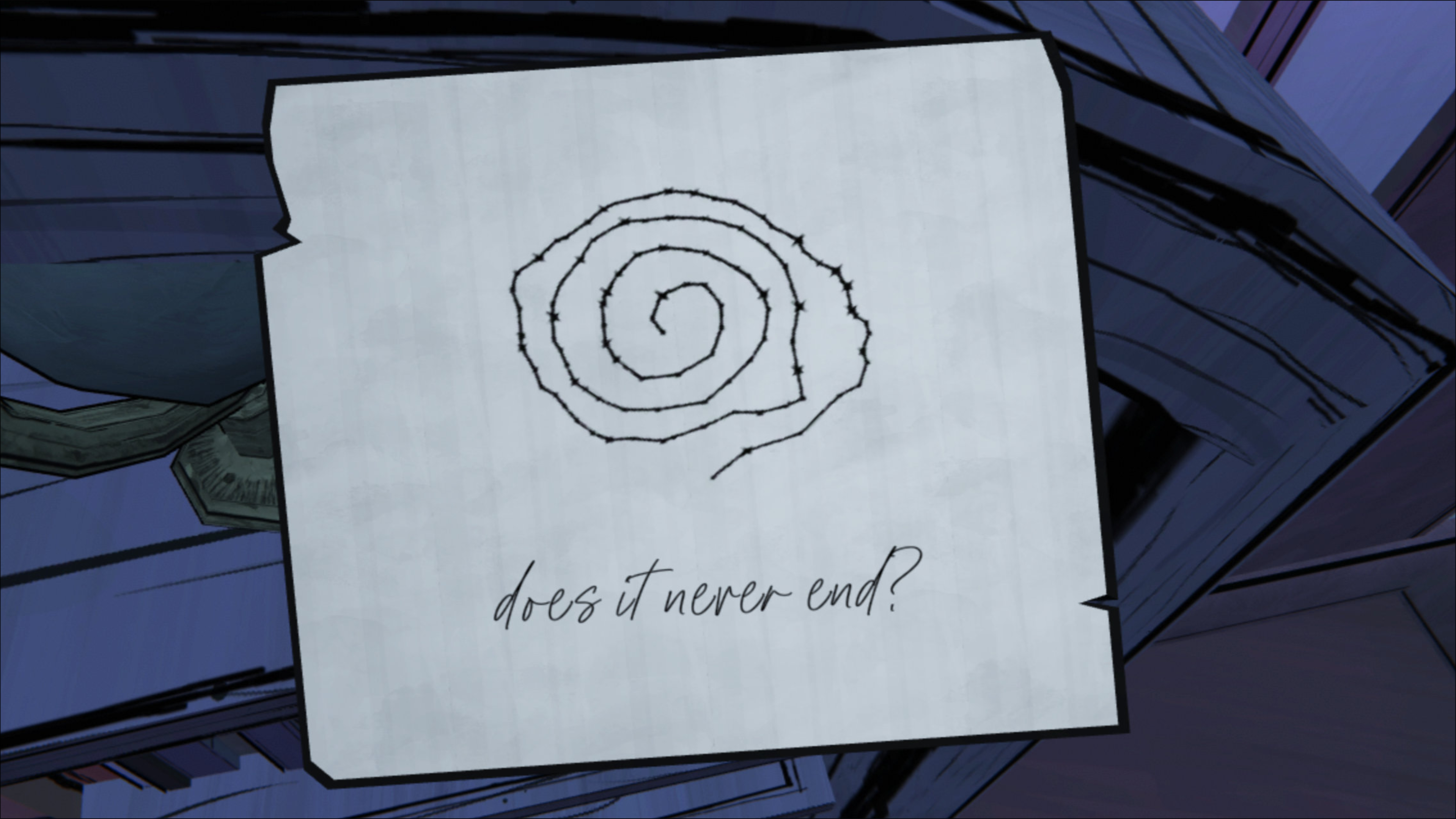 142527
Ultimately I think that Blue Prince is a game about satisfying the player's curiosity, and providing just enough information and hints to drive the player to take a deep look at the information they have, to find the next mystery to solve. However, the game does make it quite clear that purely getting the bottom of things for 'getting to the bottom of things's sake isn't quite what it is going for. One of my biggest regrets about playing Blue Prince is all the external help I got along the way- whether that was sitting in discord calls streaming the game and being led in one direction or other, or getting insight from people who hadn't even played the game on a particular puzzle to get through a mental block, or in the end, needing to resort to the internet in a couple of spots. Looking back, nothing in the game is what I would describe as truly unfair. Rather, the amount of information you have is vast, and the relevance of said information can range from dubious to critical, but how things end up is a function of the notes or pictures you thought to take, and whether you can connect the dots in the right way. With certain word based puzzles, you very well may need to consult a dictionary, but what is hard to determine is when you hit that point. Over the course of the game, particularly in the latter third or so, I gained a better intuition towards what sorts of things it was asking me to look for, or, by virtue of the possibilities narrowing as time goes on, having a better idea of what clue really sticks out in comparison to the others, but ultimately for me in the end, it wasn't enough. It's a complicated feeling, because for certain puzzles, knowing who I am and how I think, it's easy to say there's no way I would have ever gotten that, and obtain a solution and proceed, but there were also times I thought as such and gave it a day, or looked at a note later, and suddenly it came to me. All of this to say that, while I firmly reached 'the end' of Blue Prince, and it was an enjoyable ride, I did it in a way which I perceive to be incongruent with what it is truly saying or going for- in which there is some irony, but that's possibly for another time.
As such, when I did finally arrive at the ending, I have to confess that I was a bit disappointed. I had built up some kind of idea of where things would eventually end up, but found that what I got was very different. After having waited a bit to sit down and write this, in hindsight I actually think this is kind of perfect, and it has illuminated for me what I really think the game wants to express, which is a love for the process of thinking and puzzling and solving as far as, well, what you deem appropriate, or as far as it serves you.
What follows is a tad on the spoilery side, but in order to avoid really spoiling anything, I will keep it in the vaguest possible terms. At a certain point very late into the game, what I would describe as the penultimate 'ending' before the final-final-actually"final" major puzzle (which, I suppose, could be different depending on the order in which you come across things), you are given an arrangement of boxes not too dissimilar to the boxes you find in the Parlor. Opening each box carries a different result (and you can open them all over several in game days), but one in particular did end up serving as a nice bookend to one aspect of the game's underlying narrative- an aspect which I had been building up as what the 'end' would have to do with, and, if I had chosen to stop after having seen that, I probably would not have come away with that initial disappointment once I went further on. It's only really by reflecting on the game as a whole that I've been able to come to that realization, though.
To wrap up, Blue Prince experienced some level of community controversy during The Game Awards, where many fans perceived it as having been snubbed for not being a contender for Game of the Year, or for not winning Best Indie Game (which was a very stacked category, even discounting Expedition 33's controversial 'indie' status), but I don't think I feel the same. For one, I think Expedition 33 is practically a head to toes incredible package, and one which has much more compelling character writing across a wider cast than I would say Blue Prince does, but more than that, for better or worse, Blue Prince is a very unique game, as I hope I've made evident so far. I absolutely think that something being particularly unique is not reason in and of itself to deny it some award or other, but it means that the game has made decisions in terms of presentation or gameplay that while justified, can hamper the experience to some degree. Among these are things like frequent recurring lengthy animations, or how the RNG of room drafting can mean you waste several days if you're trying to go for something specific, but ultimately all these things combine to give it its identity, so should they be excised for a better chance at winning in the Game Awards? Probably not, and, speaking as a very big fan of Umineko, I'm very much for weird unique stories being the way they are. The thing that Blue Prince perhaps suffers the most from on an awards show like The Game Awards is the fact that it is a thoroughly English language game. The amount of wordplay is so thick and intricate that it's extremely difficult for me to imagine a localization realistically being possible. Almost to the extent that I would say, to try and do so means to create the Blue Prince equivalent for that particular language, you'd have to change so much. While this is a fairly large accessibility barrier, the fact that it does rely so deeply on language is exactly what gives it so much of its identity. I think that making these puzzles universal across all languages would inherently diminish the complexity and cleverness the game is able to achieve, so while it's sad that others across the world can't necessarily experience the game, it's a tradeoff which I can agree with (biased native English speaker as I am). I can only hope that games on this level can be made in other languages, in ways that get deep into it with the ways in which other languages can play with words, and I would look forward to being familiar enough with whatever languages these are to be able to enjoy them myself.
That's all for now- 'til next time!